
Why Your Puppy’s First 30 Days Matter More Than You Think
The first 30 days with a puppy in Langley is a critical behavioural imprinting period that establishes elimination routines, confinement tolerance, bite inhibition, and handler communication through structured repetition, environmental control, and reinforcement timing.
You don’t “see how it goes.”
You install patterns.
Because whatever your puppy rehearses in the first month becomes the default.
What First-Time Puppy Owners in Langley Get Wrong (And Why It Matters)
First-time puppy ownership in Langley is often defined by inconsistent routines, unclear communication, and excessive freedom that produce preventable behaviours such as indoor accidents, crate resistance, leash pulling, and biting.
Here’s what typically happens:
- The puppy has access to the full house too early
- Potty breaks are reactive, not scheduled
- The crate is introduced only when needed, not conditioned
- Biting is “managed” instead of redirected
- Commands are repeated without reinforcement clarity
The result is not random.
It’s predictable.
Because behaviour is built from:
- Repetition frequency
- Reinforcement timing
- Environmental access
Moxie Dog Training works with first-time puppy owners to replace guesswork with structured systems that produce fast, measurable behaviour changes inside real homes, not controlled classrooms.
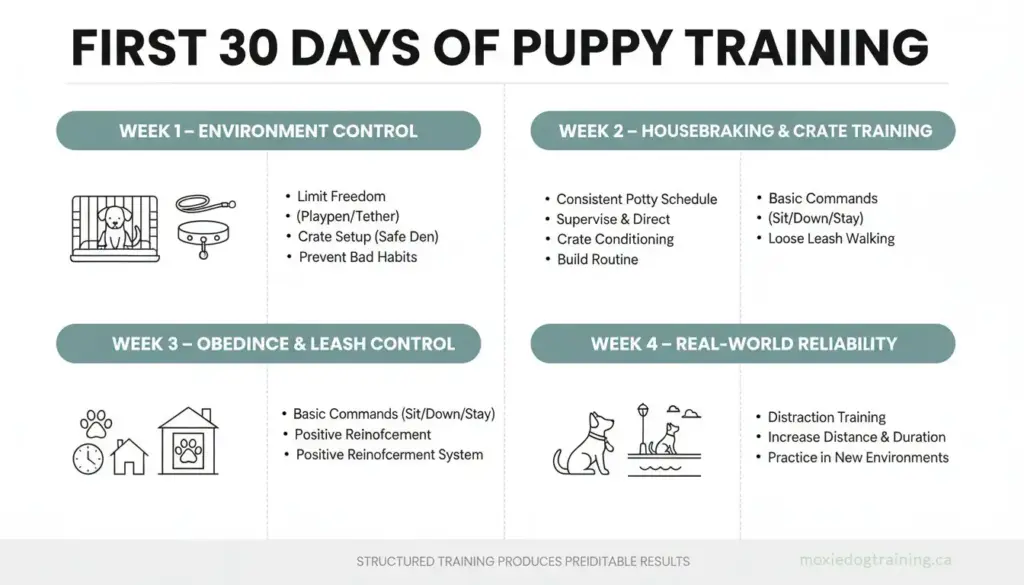
Week 1: Control the Environment Before You Train the Dog
Week one with a puppy is an environmental management phase that reduces mistakes by controlling space, access, and timing.
This is not about obedience yet.
This is about preventing bad reps.
You need:
- A crate (wire crate or plastic kennel sized to stand, turn, lie down)
- A leash and tether system for indoor control
- Baby gates or playpens to limit room access
- A defined potty area (grass, turf, gravel, or pad)
Your job in week one:
- No unsupervised freedom
- No wandering
- No “they’ll figure it out”
Micro-behaviours you are controlling:
- Where the puppy urinates
- What the puppy chews (furniture legs, baseboards, shoes)
- How the puppy moves through space (doorways, thresholds)
If you skip this step, you don’t train a puppy.
You train bad habits.
Week 2: Install Housebreaking and Crate Training Systems
Week two is a routine-building phase that establishes elimination timing, crate comfort, and predictable daily structure.
Housebreaking is a schedule system.
Not a guessing game.
You are aligning:
- Feeding times
- Water intake
- Sleep cycles
- Potty breaks
Your housebreaking system includes:
- Taking the puppy out after waking, eating, playing, and every 60–120 minutes
- Using the same elimination zone every time
- Reinforcing immediately after elimination, not after returning inside
Crate training is introduced as:
- A resting space
- A management tool
- A structure anchor
Crate micro-components:
- Door closed duration (seconds → minutes → hours)
- Positive association (feeding inside, chew toys, calm entry)
- Zero forced confinement without conditioning
If your puppy cries in the crate, it’s not stubbornness.
It’s poor conditioning.
Moxie Dog Training builds crate and housebreaking systems directly inside Langley homes, ensuring routines match real schedules, layouts, and lifestyle constraints.
Week 3: Introduce Obedience and Leash Control
Week three is a communication phase that installs basic obedience commands and leash mechanics.
Now you teach the puppy how to respond.
Not just exist.
Core commands:
- Sit (position control)
- Down (calm state control)
- Recall (come when called)
These are not tricks.
They are control systems.
Each command includes:
- Cue (word or hand signal)
- Behaviour (movement or position)
- Marker (yes, click, or verbal confirmation)
- Reward (food, toy, engagement)
Leash training starts here.
Not on your first “real walk.”
You begin with:
- Indoor leash exposure
- Controlled walking beside the handler
- Reinforcing position near your leg
Because leash pulling is not a strength issue.
It’s a reinforcement issue.
Moxie Dog Training implements leash control in real Langley environments, including sidewalks, parks, and residential streets, where distractions actually exist.
Week 4: Build Real-World Reliability
Week four is a proofing phase that generalizes behaviour across environments, distractions, and conditions.
This is where most owners fail.
Because the dog “knows it at home.”
But not outside.
You now train:
- Sit at curbs, doorways, and entrances
- Recall with distance and distractions
- Leash walking around dogs, people, and movement
Key variables you introduce:
- Distance (how far away you are)
- Duration (how long the behaviour holds)
- Distraction (what’s happening around the dog)
If you skip this step:
- Commands become optional
- Recall becomes unreliable
- Walks become chaotic
Real-world reliability is not automatic.
It is trained.
Why DIY Puppy Training Breaks Down (And Costs You More Later)
DIY puppy training is often inconsistent because timing, structure, and progression are unclear.
Common patterns:
- Reinforcing the wrong behaviour unintentionally
- Repeating cues without follow-through
- Advancing too fast without stability
This creates:
- Confusion in the dog
- Frustration in the owner
- Slower progress overall
And then:
You don’t fix behaviour.
You manage it.
Professional training changes that.
Because it installs:
- Clear systems
- Predictable routines
- Measurable outcomes
Moxie Dog Training works directly with first-time owners to build these systems inside their home, using their schedule, their environment, and their dog’s behaviour profile.
Start Your Puppy’s First 30 Days with Moxie Dog Training
First-time puppy training in Langley is most effective when structure is installed early, consistently, and within the dog’s actual living environment.
Moxie Dog Training provides:
- In-home puppy training tailored to your layout, schedule, and lifestyle
- Step-by-step systems for housebreaking, crate training, obedience, and leash control
- Real-world training that produces reliable behaviour outside controlled sessions
This is for you if:
- You don’t want to “figure it out” as you go
- You want fewer mistakes and faster progress
- You want a dog that listens in real environments, not just at home
The outcome is not just a trained puppy.
It’s a clear system:
- Predictable elimination
- Calm crate behaviour
- Controlled walking
- Reliable response to commands
Book a session with Moxie Dog Training and start with our Puppy Success program and replace uncertainty with structure from day one.