
Puppy Training: The Complete Owner’s Guide to Building a Reliable Dog from Day One
Puppy training is a structured behavioural development process that shapes elimination habits, impulse control, social responsiveness, and handler communication through environmental management, reinforcement timing, and progressive exposure during a dog’s most neurologically receptive developmental window.
It is not a luxury.
It is not something you get to when things go wrong.
It is the difference between a dog you enjoy and a dog you manage.
And the window to do it right is narrow.
What Puppy Training Actually Is (And What It Isn’t)
Puppy training is the deliberate installation of behaviour patterns, not the correction of bad ones after the fact.
Most owners enter puppyhood with the wrong mental model. They picture training as a series of commands: sit, stay, come, shake. They think it starts when the puppy is “ready.” They treat early weeks as a settling-in period where mistakes are expected and corrected later.
This is precisely backwards.
A puppy’s brain during the critical socialization period — roughly 3 to 14 weeks — and the subsequent juvenile period through 6 months is operating at peak neuroplasticity. The neural pathways being formed right now, today, in your living room, are the ones your dog will default to at 2 years old in a park full of distractions.
Behaviour is not a matter of personality.
It is a matter of rehearsal.
Every time your puppy eliminates indoors, that elimination pattern is being reinforced. Every time mouthing produces a reaction — any reaction — biting pressure is being calibrated. Every time unsupervised access to a room ends in a chewed table leg or a puddle on the rug, the dog is getting better at exactly the wrong thing.
The first 30 days are not a grace period.
They are the foundation.
The Four Pillars of Puppy Development
Puppy behavioural development rests on four interdependent training pillars, each with its own mechanics, timeline, and failure modes:
- Housebreaking — the installation of a species-specific elimination routine tied to schedule, location, and reinforcement contingency
- Crate training — the conditioning of confinement tolerance through systematic duration-building, positive association, and stress-free entry protocols
- Bite inhibition — the calibration of jaw pressure, redirection behaviour, and social communication through structured feedback and appropriate substitution
- Obedience and leash mechanics — the establishment of handler communication via cue clarity, marker systems, and proofed responses across distance, duration, and distraction
None of these operates in isolation.
Housebreaking depends on crate training. Crate training accelerates bite inhibition work. Obedience without leash mechanics produces a dog that sits beautifully in your kitchen and drags you into traffic.
The Science Behind the Schedule: How Canine Learning Works
Puppy learning is governed by operant and classical conditioning principles that make timing, repetition frequency, and environmental consistency the primary variables in behaviour outcome.
This is not abstract theory. It is the mechanism behind every result you are going to get — good or bad.
Operant Conditioning and the Four Quadrants
When a behaviour produces a consequence, that consequence determines whether the behaviour increases or decreases in frequency. The four contingencies:
- Positive reinforcement: adding something desirable after a behaviour (food reward after a sit increases sits)
- Negative punishment: removing something desirable after a behaviour (turning away when jumping reduces jumping)
- Positive punishment: adding something aversive after a behaviour (not recommended in modern puppy training protocols)
- Negative reinforcement: removing something aversive after a behaviour (releasing leash pressure when the dog moves toward you increases recall)
Effective puppy training relies primarily on positive reinforcement and negative punishment. The research consensus — from applied behaviour analysis studies, veterinary behavioural guidelines, and canine cognition research — consistently shows that aversive-based methods produce higher cortisol levels, more handler-directed aggression, and slower skill acquisition in young dogs.
The pragmatic reason to care: a dog trained through intimidation is a dog with a suppressed stress response, not a dog with installed behaviour. It looks obedient under low arousal. It falls apart under pressure.
Classical Conditioning and the Emotional Foundation
Before your puppy can learn commands, it needs an emotional baseline. Classical conditioning is what produces that baseline.
The crate is not a cage that your puppy tolerates. It is a conditioned stimulus that predicts rest, safety, and food. This distinction is everything. A puppy that has had high-value food stuffed into a Kong inside its crate for five days before the door is ever closed will enter the crate differently than a puppy that was placed inside, door shut, and left to habituate through distress.
The same applies to leash pressure, handling by strangers, veterinary examination, and exposure to traffic noise, skateboard sounds, stroller movement, and other urban stimulus classes.
Classical conditioning — pairing neutral or mildly aversive stimuli with predictably positive outcomes — is how you produce a dog that isn’t reactive, isn’t anxious, and isn’t a liability in a crowd.
The Timing Window: Why Seconds Matter
Reward delivery must occur within 1–2 seconds of the target behaviour to produce reliable conditioning. Beyond two seconds, the association between behaviour and consequence degrades rapidly. At five seconds, you are reinforcing whatever your dog is doing right now — which may be sniffing the floor, turning away, or jumping up to reach the treat you’re fishing out of your pocket.
This is why marker training (using a clicker or the verbal marker “yes”) matters. The marker bridges the gap between behaviour completion and treat delivery. The sound marks the exact moment the correct behaviour occurred, creating a precise associative memory even when the treat takes two more seconds to arrive.
Environmental Management: The Non-Negotiable First Phase
Environmental management is the deliberate control of physical space, sensory access, and movement freedom that prevents unwanted behaviour rehearsal before training systems are in place.
This is not optional scaffolding you skip when you feel confident.
It is the prerequisite for everything else.
The Management Toolkit
Every puppy owner needs six functional components in place before the dog arrives:
A size-appropriate crate. Wire crate or plastic travel kennel. Sized so the puppy can stand without hunching, complete a 180-degree turn, and lie fully extended. Too large and the dog will eliminate in the unused corner, eliminating the housebreaking advantage of confinement. Crate accessories include a washable crate mat or veterinary bedding, and a Kong or appropriate chew toy for positive crate association work.
Baby gates and exercise pens. These form the room management system. Your puppy has access only to the rooms where you are present and attentive. The open-plan living room-kitchen configuration that characterizes most modern homes is a management disaster without gates. Each gate functions as an access boundary that prevents the rehearsal of elimination accidents, destructive chewing on baseboards and furniture legs, and unsanctioned room exploration.
A drag leash. A lightweight 4-foot leash left on the puppy’s collar during supervised indoor time. This is your interruption and redirection tool. When the puppy moves toward a chew target — an electrical cable, a chair leg, a shoe — the leash provides immediate, calm redirection without a chase sequence. Chase is arousal. Arousal accelerates the unwanted behaviour pattern.
A defined elimination zone. Grass patch, gravel area, concrete pad, or indoor pee pad. One location. Every time. The specific substrate matters because dogs develop substrate preferences for elimination through early repetition. A puppy taken consistently to grass will seek grass. A puppy taken to varied locations develops a generalised indoor-outdoor indifference that extends your housebreaking timeline significantly.
High-value food rewards. Small, soft, strong-smelling treats — boiled chicken, cheese cubes, commercial training treats — in an accessible treat pouch or pocket. Kibble from the food bowl is insufficient reward salience for new behaviour acquisition. You need something the dog will reliably work for under mild distraction.
A structured daily schedule. Posted or documented. Feeding times, potty break times, nap windows, training sessions, and free play. Your puppy’s bladder capacity during early weeks is approximately 1 hour per month of age. A 9-week-old puppy needs a potty break every 60–75 minutes during waking hours. The schedule is not flexible. It is the structure within which all other training systems operate.
Housebreaking: Installing the Elimination System
Housebreaking is a schedule-and-reinforcement system that uses feeding timing, sleep cycle alignment, confinement management, and marker-based reward delivery to establish a predictable, location-specific elimination routine.
The Elimination Trigger Map
Every puppy has predictable physiological trigger events that produce the need to eliminate:
- Immediately upon waking from sleep (any sleep — night sleep, nap, 20-minute crate rest)
- Within 5–15 minutes of consuming a meal
- During or immediately following active play
- After any period of high arousal — meeting a new person, hearing a doorbell, car ride
- On a rolling 60–90 minute schedule during all waking hours
Your housebreaking protocol is a response to this trigger map. Every trigger event produces a trip to the elimination zone. Not a consideration. Not a “let’s see.” A trip.
The Reinforcement Window
When elimination occurs in the correct location, the reward is delivered immediately — within 1–2 seconds of completion. Not after returning inside. Not after the puppy sits. At the moment of completion.
This is the failure point in most owner-managed housebreaking protocols. The owner waits inside the door. The puppy eliminates, runs back in, and gets treated in the kitchen. The reinforced behaviour is “running to the kitchen,” not “eliminating on grass.”
Mark at the moment of completion. Move the reinforcement outside.
Handling Accidents
Indoor accidents during the learning period are training feedback, not character defects.
Clean with an enzymatic cleaner (products containing bacterial cultures that digest urine protein) that eliminates the olfactory residue. Standard household cleaners containing ammonia — a urine metabolite — may actually increase the probability of re-marking at that location.
Do not interrupt elimination mid-stream with noise or startlement. This produces incomplete bladder emptying and conditions anxiety around the elimination act itself. Calmly interrupt if you catch the pre-elimination sniffing and circling behaviour, move immediately to the elimination zone, and reward completion there.
Apartment and Urban Housebreaking Variations
Puppies in high-rise buildings, urban condominiums, and multi-floor residences face extended time-to-elimination-zone delays that require modified management protocols.
Indoor pee pad training is a valid intermediate housebreaking stage, not a training failure. The protocol runs in two phases: first, establish reliable pad use indoors, then gradually relocate the pad toward the building exit over several weeks as bladder capacity and physical independence increase.
Puppies with no direct outdoor access should have a designated indoor elimination surface positioned as far from sleeping and feeding areas as the space allows, consistent in texture and location.
Crate Training: Engineering Confinement Comfort
Crate training is a classical and operant conditioning process that transforms a metal or plastic enclosure into a predictive safety signal through systematic positive association-building, graduated duration exposure, and stress-response management.
Why the Crate Is Not Cruel
The crate anxiety most new owners feel about crate training is rooted in anthropomorphism. Dogs are not humans who experience confinement as punitive imprisonment. Dogs are denning species whose ancestral behaviour includes seeking small, enclosed, sheltered spaces for rest and security.
The question is not whether crates are cruel.
The question is whether the specific crate has been conditioned as a positive environment or introduced as aversive confinement.
A crate that was introduced correctly — food dispensed inside it, meals fed in it, favourite toys left in it, door open before closing was attempted — produces a dog that enters the crate voluntarily and rests there without protest.
A crate introduced without conditioning — puppy placed inside, door closed, left alone, dog distresses — produces learned helplessness, separation anxiety markers, and a 6-month-old dog that still cannot be crated without destruction.
The Conditioning Sequence
Days 1–2: Crate sits in the room with the door open. Treats are tossed inside. The puppy enters voluntarily to retrieve them. No door closing. No duration. Pure positive association with the interior space.
Days 3–5: Meals are fed inside the crate. Kong or Lick Mat is prepared and placed inside at rest times. The puppy is encouraged but never forced to enter. The door closes for 30–60 seconds while the puppy is occupied with the food item, then opens before distress signals appear.
Days 6–10: Duration is built in increments. 2 minutes. 5 minutes. 10 minutes. The threshold is always one step below where the puppy would begin vocalizing. If your puppy can tolerate 5 minutes but protests at 8, your next session targets 6 minutes. Not 8. Not 10.
Week 2 onward: Overnight confinement begins with the crate positioned in the owner’s bedroom, where the dog’s proximity to human breathing and movement provides reassurance that accelerates overnight settling. Gradually — over days, not hours — move the crate to its permanent location.
Crate Duration Guidelines by Age
- 8–10 weeks: maximum 1–1.5 hours during the day
- 10–12 weeks: maximum 2 hours daytime
- 3–4 months: maximum 3 hours daytime
- 5–6 months: maximum 4 hours daytime
- 6+ months: up to 5 hours, with appropriate exercise before and after
These are not arbitrary limits. They reflect bladder physiology. Asking a 10-week-old puppy to hold its bladder for 4 hours is not a training challenge. It is a set-up for failure that erodes housebreaking progress and produces anxiety responses around confinement.
Bite Inhibition: Teaching Jaw Pressure Control
Bite inhibition is the learned reduction of jaw pressure and biting frequency through social feedback, redirection to appropriate chew substrates, and handler-consistent response protocols that communicate bite-force parameters without suppressing normal puppy play drive.
Why Puppies Bite and Why It Matters
Puppy mouthing, nipping, and biting are developmental behaviours — not aggression, not dominance, not defiance.
Young dogs calibrate jaw pressure through play with littermates. When a puppy bites too hard during play, the littermate yelps and withdraws. Play stops. The biting puppy learns, through social feedback iteration, that hard biting ends the game.
Puppies removed from the litter before 7–8 weeks have had less of this calibration. Puppies from pet stores or mill environments may have had none. They arrive in your home without a jaw pressure map.
Your job is to finish the calibration process — using the same mechanism their littermates used.
The Feedback Protocol
When a puppy bites with pressure that exceeds your threshold:
- A single, calm, non-dramatic yelp sound — not shouted, not theatrical — and immediate withdrawal of the hand, limb, or body part that was bitten.
- End the interaction. Turn away. Still yourself. This is a 3–5 second social timeout.
- Reinitiate play. If the pressure-bite recurs, the timeout extends.
This protocol teaches: hard biting ends the good thing.
What does not work:
- Yelling, because yelling is arousal-amplifying stimulation, not a punishment signal
- Holding the muzzle closed, because this produces defensive biting and hand-phobia
- Tapping or flicking the nose, because pain-based corrections on soft-muzzled puppies produce bite-escalation and handler wariness
- Redirecting to a toy every single time, because redirecting alone without social withdrawal skips the feedback step
Redirection to appropriate chew substrates — bully sticks, frozen Kongs, antlers, rubber chew toys — is the second phase of the protocol. After the withdrawal and short timeout, re-engage with a toy. Reward engagement with the toy.
Puppy Socialization and Bite Context
Bite inhibition does not exist independently of socialization. A puppy that has been appropriately exposed to children, men with beards, people in hats, wheelchairs, joggers, cyclists, other dogs, and high-traffic pedestrian environments will have better arousal regulation under social pressure — which is when biting incidents most commonly occur.
The critical socialization window closes around 14–16 weeks. After that point, novel stimuli that the dog has never encountered produce much stronger fear and avoidance responses. The bite inhibition work you do in an under-socialized dog is harder, slower, and less complete.
Obedience Training: Installing the Communication System
Obedience training is a handler-dog communication system built on cue clarity, marker precision, and progressive reward delivery that produces reliable behaviour responses across increasingly challenging contexts.
The Foundation Commands and Their Functional Purpose
Sit. The position-control command. Produces stillness, interrupts forward motion, establishes handler focus. The foundation for door manners, street-crossing behaviour, greeting protocols, and veterinary examination compliance.
Down. The calm-state command. Produces sustained low arousal, prevents jumping, anchors a stay position for extended durations. Behaviourally, the down position is less activating than sit — useful for high-distraction environments.
Stay. The duration and distance modifier. Applied to both sit and down. Teaches the dog that a position holds until released, not until it chooses to break. The three D’s of stay — Distance, Duration, Distraction — are trained independently, then combined.
Come (Recall). The safety command. Your puppy’s willingness to interrupt whatever it is doing and return to you is potentially life-saving. It is also the command most consistently undermined by owners who call the dog back and do something the dog doesn’t enjoy: bath, nail trim, ending of off-leash play. Recall must be paired exclusively with positive outcomes during the learning phase.
Leave it / Drop it. The resource management commands. Leave it redirects attention before engagement. Drop it releases an already-held item. These are not the same command. Both are critical for managing the puppy’s tendency to ingest dangerous substances, food scraps, dead animals, and other items of intense interest.
Place / Go to your mat. The station command. Sends and maintains the dog on a designated mat or bed. Enormously useful for managing door greetings, mealtimes, household guests, and any scenario where you need the dog out of a specific area.
Marker Training: Why It Works Better
Marker training uses a conditioned stimulus — a clicker click or a single verbal marker such as “yes” — to bridge the gap between behaviour and reward delivery.
The marker is a promise. It says: that behaviour, that exact one, right now, is going to be rewarded. The reward can follow 1–3 seconds later because the marker has bridged the timing gap.
Compared to luring and reward delivery without a marker:
- Cleaner behaviour shaping because the dog understands exactly what produced the reward
- Faster extinction of undesired elements (extra steps, head turns, position breaks)
- Better stimulus control — the dog learns the difference between the cue and random behaviour trials
- Stronger generalization across contexts
The Training Session Structure
Puppy training sessions should be:
- 3–5 minutes for puppies under 12 weeks
- 5–10 minutes for puppies 12–16 weeks
- 10–15 minutes for puppies 4–6 months
Frequency matters more than duration. Four 5-minute sessions per day produce faster behaviour acquisition than one 20-minute session. The distributed practice effect in learning science applies to dogs as directly as it applies to humans.
End every session on success. If the session is deteriorating — puppy is distracted, not responding, visibly fatigued — drop to a previously mastered command, mark and reward it, and end there. The last repetition in a session is the most strongly encoded.
Leash Training: Walking Without War
Leash training is a behaviour-shaping process that establishes loose-leash walking mechanics, directional responsiveness, and handler-proximity reinforcement through controlled progression from indoor to outdoor environments with increasing distraction exposure.
The Pulling Problem
Leash pulling is the most common complaint from first-time dog owners and the behaviour most consistently misunderstood.
Pulling is not stubbornness. It is not dominance. It is not a large-breed problem.
It is a reinforcement history problem.
Every time a pulling dog gets where it wants to go — sniffs the bush, reaches the other dog, arrives at the park — the pulling is reinforced. The dog has learned that pulling produces forward progress. The equation is simple: pull → advance → repeat.
The solution is equally simple, but requires consistency that most owners underestimate: forward movement is contingent on a loose leash. A tight leash means no forward progress. A loose leash means forward progress resumes.
This is the only rule.
It requires stopping and standing still — not yanking, not jerking, not using the lead as a corrective instrument — every single time the leash goes tight. Owners who manage pulling by pulling back train a dog to pull against pressure. They have taught opposition reflex. The result gets worse, not better, over time.
Starting Indoors
Leash training begins indoors, before outdoor environments and their density of olfactory, visual, and auditory stimulation are introduced.
Start with a flat collar or correctly fitted front-clip harness and a 4–6 foot leash. Walk the dog through the house. Mark and reward the moment the dog is beside your leg with the leash loose. Stop the instant the leash tightens. Resume when it loosens.
The dog learns the mechanical rule in low-distraction conditions. Then the rule moves outside.
Equipment Selection
The puppy training equipment spectrum:
Flat collar. Appropriate for puppies with good preliminary leash mechanics. Does not support leash training in dogs that pull hard, as collar pressure on a trachea-level attachment point during pulling presents injury risk.
Front-clip harness. Redirects the dog toward the handler when tension is applied to the leash. Can reduce pulling without aversive mechanics. Commonly recommended for most puppy leash training programs.
Head halter (Gentle Leader, Halti). Controls the direction of the head, which controls the direction of the body. Requires careful conditioning to overcome the dog’s aversion to nose-band pressure. Effective for highly aroused, large-breed pullers. Not appropriate as a first-day tool.
Prong collar and slip collar. Not recommended for puppies, not recommended for puppies by modern veterinary behaviourist consensus, not used in contemporary positive reinforcement training protocols.
Socialization: The Developmental Investment That Pays Forever
Socialization is the structured, positive-exposure process during which a puppy develops appropriate emotional and behavioural responses to novel stimuli — people, animals, environments, sounds, surfaces, and handling — within the critical developmental window of 3 to 14–16 weeks.
The Socialization Window and Its Limits
The socialization window is biological, not opinion.
Between 3 and 14 weeks, a puppy’s brain has a dramatically lower threshold for forming neutral-to-positive associations with novel stimuli. New things encountered during this window are processed as normal features of the world. New things encountered after this window close are processed with increasing vigilance, fear, and avoidance.
This does not mean an under-socialized adult dog cannot improve. It means improvement is slower, less complete, and requires more targeted intervention.
Every week inside the socialization window is worth months of rehabilitation work later.
What Socialization Actually Means
Socialization is not exposure. It is positive exposure.
A puppy that attends a puppy class where it is overwhelmed, plays with inappropriate dogs, and leaves in a heightened stress state has been exposed. It has not been socialized.
Socialization requires:
- Exposure to the target stimulus at an intensity below the fear threshold
- Pairing with food, play, or positive handler interaction during exposure
- Successful completion of the exposure — the puppy remains below threshold, explores freely, shows approach behaviour rather than avoidance
The stimulus list should be exhaustive. People of different ages, sizes, genders, skin tones, mobility devices, and clothing types. Children in strollers, children running, children crying. Dogs of different sizes, breeds, and play styles. Cats. Livestock if applicable to the environment. Veterinary handling — paw manipulation, ear examination, mouth opening. Grooming tools — brushes, nail trimmers, blow dryers. Surfaces — grass, gravel, metal grates, wooden decks, linoleum, carpet. Vehicles — cars, bicycles, motorcycles, buses. Urban sound environments.
The Vaccination Timing Dilemma
The apparent conflict between veterinary advice to keep unvaccinated puppies away from unknown dogs and trainer advice to socialize during the window before 14–16 weeks is real but navigable.
The American Veterinary Society of Animal Behaviour position statement (updated guidance) supports socialization in controlled environments before full vaccination is complete, because the risk of behavioural problems from under-socialization exceeds the risk of disease transmission in controlled settings.
Practical guidelines:
- Puppy classes that require proof of initial vaccination and run on cleaned indoor surfaces are appropriate
- Homes of known, vaccinated dogs are appropriate
- High-traffic unknown-dog areas — dog parks, pet store floors — are not appropriate until full vaccination
Common Puppy Training Mistakes and How to Avoid Them
Mistake 1: Too Much Freedom Too Soon
Free roaming access to a full house during the first weeks is the single most common and most preventable training error. The result is a puppy that has rehearsed indoor elimination across multiple rooms, developed chewing habits across multiple furniture items, and learned that the entirety of the house is its territory.
Management, not training, is the first phase. Earn freedom incrementally.
Mistake 2: Inconsistent Rules
Dogs are pattern learners. They learn the rules of their specific environment from repetitive contingency. If jumping on the couch is sometimes allowed and sometimes forbidden, the dog learns that the couch is a probabilistic resource — and it rehearses the trial behaviour of jumping up to test the current probability.
Every family member must follow the same rules. This includes grandparents who visit twice a year and think it’s fine to feed from the table.
Mistake 3: Repeating Commands
A cue said once and followed up on teaches the dog what the cue means. A cue said five times in escalating urgency teaches the dog that the first four repetitions are noise.
Say it once. Follow through. If the behaviour doesn’t occur, make the follow-through happen, then reward the outcome.
Mistake 4: Punishment After the Fact
Punishing a dog for something that happened in the past — returning home to find a destroyed sofa cushion and scolding — does nothing except produce a dog that is anxious when you arrive home. The dog cannot connect the past behaviour to the present punishment. The guilt face is not guilt. It is appeasement behaviour triggered by your body language and tone.
Prevent future incidents through management. Address current incidents if you catch them in the act.
Mistake 5: Training in Only One Environment
A command trained exclusively in the living room is a living room command. Puppies learn in context. The sit that is rock-solid at home becomes invisible when the dog is 20 feet from another dog in a park.
Proof behaviour across environments, distances, and distractions. This is not bonus work. It is the completion of training.
When to Start Professional Puppy Training
Professional puppy training is most effective when initiated during the first two weeks of ownership — ideally within days of the puppy coming home — when management systems, housebreaking protocols, and crate conditioning can be installed before problematic behaviour patterns are established.
The cost of waiting:
By 12 weeks, housebreaking accidents have produced location preferences for indoor elimination. By 14 weeks, the socialization window is closing. By 16 weeks, biting has been reinforced and calibrated upward through inadvertent owner responses. By 6 months, the “training” being requested is actually behaviour modification for established problems — a harder, slower, more expensive process.
What In-Home Training Offers That Group Classes Don’t
In-home professional training occurs in the environment where behaviour problems actually exist — not a controlled classroom that shares nothing except dog-and-owner proximity with your real daily life.
The protocols are designed around your floor plan, your schedule, your family configuration, your specific dog’s arousal threshold, and the actual distractions present in your neighbourhood.
Group puppy classes have value for socialization exposure. They have limited value for installing management systems, troubleshooting housebreaking failures, or addressing crate-resistance in a dog that has already been conditioned negatively.
How to Evaluate a Puppy Trainer
Look for:
- Least-invasive minimally aversive (LIMA) methodology
- Evidence-based protocols traceable to applied behaviour analysis and behavioural evidence
- Willingness to provide references and to explain the rationale behind each training decision
- Experience with your specific breed type (herding breeds, terrier breeds, guardian breeds, and toy breeds each have distinct behavioural profiles that affect training approach)
- A first-session assessment that includes the environment, the owner’s schedule, and the dog’s individual behaviour history
Avoid trainers who:
- Cite dominance theory as a training rationale
- Use prong collars, e-collars collars, or slip leads as puppy training tools
- Cannot explain the learning science behind their methods
- Guarantee results in a single session without ongoing owner education
The 30-Day Puppy Training Timeline: Week by Week
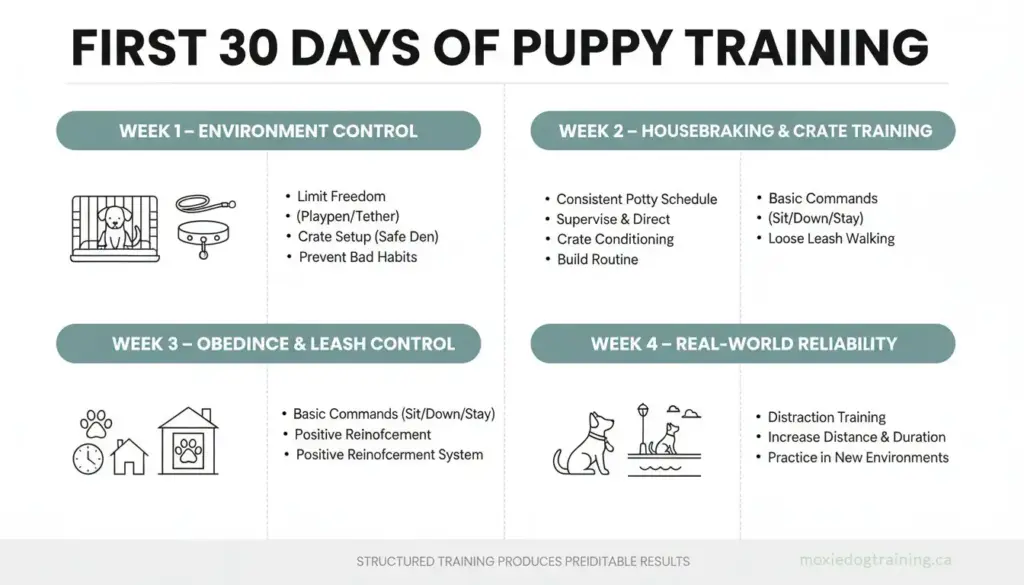
Week 1: Environmental Setup and Management Installation
The first week is a management phase focused on physical space configuration, elimination zone designation, crate introduction, and supervised confinement protocols.
Target outcomes: No unsupervised access, drag leash installed, crate door conditioning initiated, elimination zone established and in use.
Week 2: Housebreaking and Crate Duration Building
The second week is a routine-installation phase focused on schedule adherence, elimination trigger mapping, crate duration progression, and reinforcement delivery accuracy.
Target outcomes: Elimination accidents reduced by 50–70% from week 1 baseline, puppy entering crate voluntarily, overnight confinement established without prolonged distress.
Week 3: Foundation Obedience and Leash Mechanics
The third week is a communication-installation phase introducing sit, down, recall, and leave-it in low-distraction indoor contexts with marker and reward delivery systems.
Target outcomes: Reliable sit and down in familiar environments, initial leash walking mechanics established indoors, recall response to name and come cue.
Week 4: Proofing, Generalisation, and Real-World Exposure
The fourth week is a proofing phase that extends trained behaviours across outdoor environments, higher distraction contexts, and increased distance and duration parameters.
Target outcomes: Commands functional in at least three different environments, loose-leash walking initiated outdoors, sit and recall holding under mild distraction.
Breed-Specific Puppy Training Considerations
Puppy training protocols share a universal mechanical foundation but require breed-appropriate adjustments in reward salience, arousal management, training duration, and socialisation emphasis.
Herding breeds (Border Collie, Australian Shepherd, Kelpie, Belgian Malinois): High working drive, high environmental sensitivity, and early-onset object fixation require intensive mental stimulation, careful arousal management, and early introduction of impulse control work. These breeds tend to develop compulsive behaviour patterns — fence running, shadow chasing, ball obsession — when under-stimulated before 6 months.
Terrier breeds (Jack Russell, Bull Terrier, Staffordshire, Airedale): High prey drive, high environmental independence, and lower handler-orientation relative to herding breeds require stronger reinforcement salience, shorter training sessions, and early recall work. Independent problem-solving is a terrier feature, not a training failure.
Guardian breeds (Rottweiler, Cane Corso, Boerboel, German Shepherd): Early and intensive socialisation is essential. These breeds have a broader territorial instinct and stronger alarm response that, without early positive exposure to strangers, children, and novel environments, produces adult dogs with significant management challenges.
Toy breeds (Chihuahua, Maltese, Pomeranian, Yorkshire Terrier): Vulnerability to Small Dog Syndrome — a set of problem behaviours produced not by breed genetics but by inconsistent handling and training exemptions applied by owners who find the behaviour cute in a small package — requires the same training rigour applied to larger breeds. Size does not exempt a dog from needing manners.
Scent hounds (Beagle, Bassett Hound, Bloodhound): Olfactory fixation produces training challenges in outdoor environments where nose-to-ground behaviour overrides handler cues. High-value food rewards, shorter outdoor training sessions, and early recall-at-a-distance work are the priority.
Nutrition, Sleep, and Arousal: The Training Variables Owners Ignore
Sleep
Puppies require 16–18 hours of sleep per 24-hour period. This is a developmental neurological requirement, not a preference.
An overtired puppy is not a puppy that is misbehaving or being defiant. It is a puppy whose prefrontal cortex activity — the neural basis for impulse control, learning, and response inhibition — has been compromised by sleep deprivation.
Structured nap schedules are not optional if you want your training sessions to be productive. A puppy that is 45 minutes overdue for a nap will not learn. It will zoom, bite, ignore cues, and produce an owner who concludes that training “doesn’t work” on their dog.
Nutrition
Feeding a nutritionally complete, life-stage-appropriate puppy formula affects behaviour through two mechanisms:
- Blood glucose stability: Highly processed, high-glycaemic-index kibble produces energy spikes and crashes that create unpredictable arousal windows. Premium, protein-first formulas produce more stable energy profiles and more consistent training performance.
- Food as reinforcement: Using a portion of the daily food allocation for training sessions rather than feeding it exclusively from the bowl increases the reinforcement value of food rewards without adding calories. A puppy that has eaten a full meal is a less motivated training partner than one working with scheduled food allocation.
Arousal Management
Arousal is the energetic and attentional state of the dog. Low arousal produces lethargic, under-responsive dogs. High arousal produces impulsive, over-reactive dogs. Training occurs most efficiently in the moderate arousal band — alert and engaged, not frantic or flat.
Arousal management tools:
- Structured physical exercise (age-appropriate; avoid forced long walks and repetitive fetch sessions in puppies under 6 months due to growth plate vulnerability)
- Sniff walks — loose-leash walks that allow unrestricted sniffing, which are more cognitively tiring than physical exercise alone
- Food puzzles and Kong enrichment
- Calm owner body language (owners who move quickly, speak loudly, and interact with high physical energy reliably produce high-arousal dogs)
Frequently Asked Questions About Puppy Training
At what age can I start training my puppy?
Immediately. The day the puppy arrives. You are training the puppy from the first interaction — whether or not you intend to be. The question is whether you are training the behaviours you want or the behaviours you don’t.
How long does puppy training take?
Basic obedience and management system installation requires a consistent 30-day foundation period. Full behaviour reliability across diverse real-world environments takes 3–6 months of ongoing practice and proofing. Some breeds and individuals take longer. The timeline is always shortened by professional guidance and lengthened by owner inconsistency.
Is my puppy too old to start training?
No. The optimal window is early. But a 6-month-old, a 12-month-old, and even a 3-year-old dog can be trained using the same learning science principles. The protocols adjust for the established behaviour history, but the mechanics are identical.
My puppy failed puppy school. What do I do?
Group puppy classes fail primarily for two reasons: the class environment was too stimulating for productive learning, or the training methods weren’t compatible with the dog’s individual profile. In-home training in a familiar, manageable environment is the recommended next step for dogs that struggled in group contexts.
How do I train a puppy when I have kids?
Children and puppies coexist well under two conditions: children understand and consistently apply the same rules as adults, and the puppy has sufficient management and structure that uncontrolled interactions are minimised. Children should be involved in training sessions under adult supervision — it teaches the puppy that children are also communication partners, not just arousal triggers.
The Long Game: What Puppy Training Builds
A trained puppy is not the outcome.
A trained puppy is the starting point.
What the first 30 days of structured training actually builds is a communication language between you and your dog, a reinforcement history that makes your attention and your rewards valuable, and a set of behaviour patterns that generalize into the dog’s adult life.
The dog that was reliably crate-trained at 10 weeks doesn’t develop separation anxiety at 2 years. The dog that developed bite inhibition by 14 weeks doesn’t become the dog that bites a child at a family gathering. The dog that learned loose-leash walking at 12 weeks doesn’t drag an elderly family member onto a road at 3 years.
Every hour invested in the first 30 days is compounded over the next 12 years.
That is the return on puppy training.
Not tricks.
Not compliance.
A dog you can live with, travel with, and trust; in every environment, in every situation, for the entirety of your pups life.
Moxie Dog Training provides in-home puppy training for first-time owners in the Langley area, with structured programs for housebreaking, crate training, bite inhibition, foundation obedience, and leash mechanics. Programs are built around your schedule, your home layout, and your puppy’s individual behaviour profile.